Before the Ground Shakes: The Probabilistic Science Quietly Transforming Earthquake Preparedness
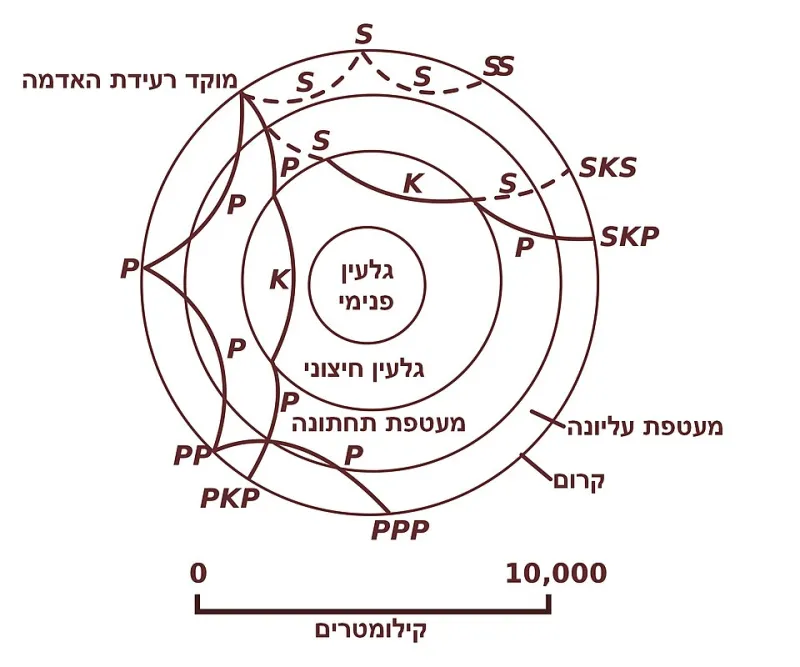
Photo: Earthquake_wave_paths.svg: SEWilco derivative work: דקי (talk), Public domain, via Wikimedia Commons
The popular image of earthquake science is one of helplessness. Seismologists, the story goes, can tell you where fault lines run and how much energy they have historically released, but they cannot tell you when the ground will next move — not within a decade, let alone a day. That image is not entirely wrong. But it is increasingly incomplete. A generation of researchers working at the intersection of probability theory, stochastic processes, and geophysics is building forecasting tools that are changing what scientists can responsibly claim to know — and what emergency managers can act upon.
The Myth of Pure Randomness
The claim that earthquakes are entirely unpredictable contains a kernel of truth and a substantial misleading implication. Individual rupture events are, in practice, extraordinarily difficult to forecast with the precision that the public associates with weather prediction. The physical processes governing fault behavior operate across timescales ranging from seconds to centuries, involve materials and pressures inaccessible to direct observation, and interact with a degree of nonlinear complexity that resists simple modeling.
But randomness in the everyday sense — the idea that all times and all places are equally likely to experience a major earthquake — is demonstrably false. Seismic hazard is highly concentrated geographically, temporally clustered in ways that follow identifiable statistical patterns, and influenced by prior seismic activity in ways that can be quantified. The science of exploiting those patterns to generate probabilistic forecasts is the discipline known as stochastic seismology, and it has made substantial progress in the past two decades.
A stochastic process, in the mathematical sense, is one governed by probability distributions rather than deterministic equations. Rather than predicting a single outcome, a stochastic model generates a range of possible futures, each assigned a likelihood. Applied to seismology, this framework allows researchers to ask not "when will the next earthquake strike?" but rather "given everything we know about this fault system, what is the probability of a magnitude 6.5 or greater event occurring in this region within the next thirty years?" That is a very different — and far more tractable — question.
UCERF and the Architecture of Probabilistic Hazard
The most ambitious application of stochastic seismic modeling in the United States is the Uniform California Earthquake Rupture Forecast, maintained by the United States Geological Survey in collaboration with the California Geological Survey and the Southern California Earthquake Center. The current iteration, UCERF3, represents a comprehensive probabilistic model of seismic hazard across California's complex network of faults.
At its mathematical core, UCERF3 uses a variant of a Poisson process — a stochastic model that describes events occurring independently at a constant average rate — modified to account for the time-dependent behavior of fault segments. Faults that have not ruptured recently are treated as having accumulated stress, making them statistically more likely to produce a large event. This modification, grounded in the physics of elastic rebound theory, transforms a simple Poisson model into a more sophisticated renewal process.
The model also incorporates epidemic-type aftershock sequence (ETAS) models, which describe how the occurrence of one earthquake raises the short-term probability of subsequent events in the surrounding region. ETAS models, originally developed by Japanese seismologist Yosihiko Ogata in the 1980s, are now standard tools in operational earthquake forecasting worldwide. They are, mathematically, a form of self-exciting point process — a stochastic framework in which each event increases the instantaneous rate of future events for a period that decays according to a power law.
The practical outputs of models like UCERF3 are not predictions in the colloquial sense. They are probability distributions — maps of expected shaking intensity over defined time horizons that feed directly into building codes, insurance pricing, infrastructure investment decisions, and emergency management planning. When the state of California mandates seismic retrofitting standards for unreinforced masonry buildings, those standards are grounded in probabilistic hazard calculations derived from stochastic seismic models.
The Forecasting Frontier
Beyond the established framework of long-term probabilistic hazard assessment, researchers are pushing toward shorter-term operational forecasting — models that can update their probability estimates in near-real time as seismic activity evolves. Following a significant earthquake, the probability of a larger aftershock — or, in some cases, a foreshock to an even greater rupture — changes dramatically over days and weeks. Communicating those changing probabilities to the public and to emergency managers is both a mathematical and a communications challenge.
The 2019 Ridgecrest earthquake sequence in Southern California provided an important test case. Within hours of the initial magnitude 6.4 event, USGS researchers issued probabilistic forecasts indicating elevated probabilities of subsequent larger events. The following day, a magnitude 7.1 rupture occurred — consistent with, though not guaranteed by, those forecasts. The episode demonstrated both the genuine predictive signal contained in short-term stochastic models and the difficulty of translating probabilistic statements into actionable public guidance.
Machine learning is beginning to augment traditional stochastic approaches. Neural network models trained on historical seismic catalogs are showing promise in identifying subtle precursory patterns that classical statistical models miss. However, the interpretability challenges associated with deep learning architectures create significant obstacles to operational deployment — a concern that echoes broader debates in applied mathematics about the trade-off between predictive accuracy and scientific transparency.
Attracting Mathematical Talent to a Difficult Field
Despite the intellectual richness of stochastic seismology, the field has historically struggled to attract top mathematical talent. The reasons are partly structural. Seismology sits at an interdisciplinary boundary where pure mathematicians may feel insufficiently grounded in geophysics and geophysicists may lack the advanced probabilistic training needed to push the stochastic modeling frontier forward. Funding streams for applied mathematics in geoscience are narrower than those available in fields like finance or machine learning, where similar mathematical skills command substantially higher compensation.
For students with strong backgrounds in probability theory, stochastic processes, or computational statistics, however, seismic science offers something that many better-compensated fields do not: problems of genuine social consequence that remain mathematically open. The question of how to optimally combine heterogeneous data sources — GPS measurements, historical seismicity catalogs, geodetic strain rates, geological slip records — into a unified probabilistic framework is an active research challenge with direct implications for public safety in some of America's most densely populated regions.
Universities including Caltech, MIT, and the University of Washington maintain active research programs at this intersection, and USGS earthquake science centers in Pasadena, Menlo Park, and Golden, Colorado, regularly collaborate with academic mathematicians on model development. For a student willing to engage with the full complexity of an unsolved problem, few fields offer a more direct line between mathematical innovation and human welfare.
What Probability Can and Cannot Promise
It is worth being clear about the limits of what stochastic seismology offers. No probabilistic model, however sophisticated, will ever tell a resident of Los Angeles that the next great Southern California earthquake will occur on a specific date. The mathematics does not permit that level of precision, and claiming otherwise would be scientifically dishonest.
What stochastic modeling can offer is something arguably more valuable: a rigorous, quantitative framework for decision-making under uncertainty. It can tell planners how much seismic risk to design against, insurers how to price catastrophic risk, and communities how urgently to invest in resilience. In a country where seismic preparedness has historically lagged well behind the scale of the hazard, that kind of mathematical clarity is not a consolation prize. It is a foundation for rational action.