The Hidden Mathematics Holding the Internet Together: Why Graph Theory Belongs in Every Classroom
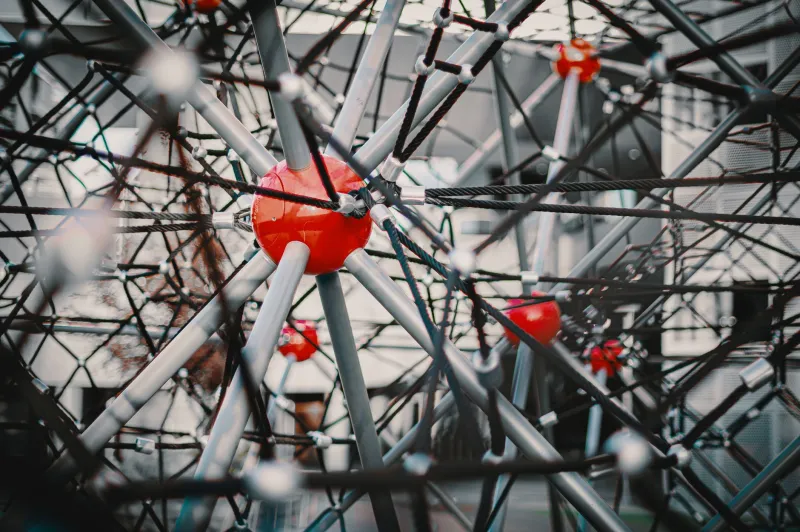
Every time a student opens a navigation app, scrolls through a social media feed, or streams a video, they are the end user of a mathematical system most of them will never formally study. Graph theory — a discipline born in an eighteenth-century puzzle about bridges in a Prussian city — is the structural language of the modern internet. It governs how data travels, how relationships are mapped, and how billions of decisions are made in milliseconds. And yet, in the typical American K-12 mathematics sequence, it is almost entirely absent.
This is not a minor curricular oversight. It is a significant gap between the mathematics students learn and the mathematics that shapes their world.
From Königsberg to the Cloud
The origins of graph theory are remarkably approachable. In 1736, the Swiss mathematician Leonhard Euler was presented with a recreational problem: could a person walk through the city of Königsberg, crossing each of its seven bridges exactly once? Euler proved that no such walk was possible, and in doing so, he established the foundational concepts of what would become graph theory. His insight was to strip the problem down to its essential structure — land masses as points, bridges as connections — and reason about the relationships between them.
That same act of abstraction, representing complex systems as nodes and edges, is precisely what makes graph theory so powerful. A social network is a graph. The internet's physical infrastructure is a graph. A GPS routing system is a graph. A recommendation algorithm is a graph. The discipline Euler invented to solve a bridge puzzle now underpins the architecture of the digital economy.
The Scope of What Students Are Missing
Consider how many daily technologies rely directly on graph-theoretic principles. Google's PageRank algorithm, which determines the order of search results, is built on the mathematics of directed graphs and eigenvalue analysis. Facebook and LinkedIn use graph databases to model relationships between users, enabling friend suggestions and professional network analysis. Spotify's Discover Weekly playlist feature analyzes listener behavior through graph-based collaborative filtering. Even the routing protocols that determine how an email travels from a server in Chicago to a recipient in Los Angeles depend on shortest-path algorithms — most notably Dijkstra's algorithm — that are pure graph theory.
None of this is peripheral or exotic mathematics. It is the operational core of trillion-dollar industries. And yet, a student who completes four years of high school mathematics in the United States — including algebra, geometry, precalculus, and even AP Calculus — may never once encounter a formal discussion of graphs, nodes, edges, or network traversal.
Why the Curriculum Gap Persists
The absence of graph theory from standard K-12 curricula is not entirely arbitrary. American mathematics education has historically been organized around a preparation-for-calculus framework, meaning the sequence of arithmetic, algebra, geometry, and analysis has been treated as the essential ladder every student must climb. This structure made considerable sense in an era when calculus represented the gateway to physics, engineering, and the natural sciences.
But the landscape of quantitative careers has shifted dramatically. Computer science, data science, network engineering, epidemiology, logistics, and artificial intelligence research all draw heavily on discrete mathematics — the broader field that includes graph theory — rather than exclusively on continuous calculus-based mathematics. The curricular pipeline has not kept pace with this transformation.
There is also the matter of teacher preparation. If graph theory is not part of standard undergraduate mathematics requirements for education majors, and if state standards do not explicitly call for it, then most teachers will not have encountered it in any formal context. Curricular reform requires not just updating standards documents but investing in professional development that equips educators to teach unfamiliar material with confidence.
Making Abstract Networks Tangible
One of the most compelling arguments for introducing graph theory earlier is how naturally it connects to problems students already find interesting. Unlike some areas of advanced mathematics, graph theory does not require years of prerequisite knowledge. Its core ideas are visually intuitive and can be introduced through activities that feel more like puzzles than formal instruction.
Middle school students can map the social connections within their own classroom as a graph and then investigate questions about influence, connectivity, and the shortest path between any two students. High schoolers can analyze real transportation networks — the subway map of New York City, for instance, or the highway connections between major American cities — and apply concepts like spanning trees to think about infrastructure efficiency. Computer science elective courses, which are expanding across the country, offer a natural home for graph algorithms, where students can write code to implement breadth-first search or model the spread of information through a network.
Platforms like Khan Academy have begun introducing discrete mathematics topics, and organizations such as the Art of Problem Solving have long incorporated combinatorics and graph theory into their competition-focused curricula. The materials exist. The challenge is integration into mainstream instruction rather than relegation to enrichment programs that reach only a self-selecting subset of students.
The Equity Dimension
There is an equity argument embedded in this curricular conversation that deserves direct acknowledgment. Advanced mathematical topics that appear in competition mathematics or elite university courses tend to benefit students who already have access to enrichment resources — tutoring, math circles, well-resourced schools. When graph theory is treated as an elective curiosity rather than a core competency, the students most likely to encounter it are those who are already advantaged.
Broadening access to discrete mathematics, including graph theory, as part of standard instruction rather than optional enrichment is a meaningful step toward ensuring that students from all backgrounds are prepared for the quantitative demands of technology-sector careers. A student in a rural school district who has never attended a math circle and cannot afford a private tutor deserves the same exposure to the mathematics of the internet as a student in a well-funded suburban district.
A Call for Curricular Courage
Reforming mathematics education is never simple. Standards bodies, textbook publishers, assessment designers, and teacher preparation programs all move on long timelines, and change requires sustained advocacy from researchers, educators, and policymakers simultaneously. But the case for graph theory is unusually strong precisely because the real-world evidence is so visible and so immediate.
Students do not need to be convinced that the internet is important. They do not need to be persuaded that social networks, GPS systems, and recommendation algorithms affect their lives. What they need is for educators and curriculum designers to make the connection explicit — to show them that the mathematics describing these systems is learnable, approachable, and genuinely fascinating.
Euler solved a bridge problem and accidentally invented a discipline that would one day hold the internet together. That is exactly the kind of story that belongs in a mathematics classroom. It is time to put it there.