Logic, Sets, and Loops: The Discrete Mathematics Gap That Is Quietly Costing American Graduates Their Dream Jobs
The Credential That Does Not Match the Job
Every year, thousands of computer science graduates walk across commencement stages clutching diplomas that represent four years of coursework. They have survived calculus sequences, physics labs, and late-night debugging sessions. And yet, within weeks of starting their first professional roles, many discover an uncomfortable truth: the mathematics they spent years studying does not map cleanly onto the problems their employers actually need them to solve.
The missing piece, according to a growing chorus of educators and hiring professionals, is discrete mathematics — a branch of the discipline concerned with countable, distinct structures rather than continuous change. Combinatorics, propositional logic, set theory, graph algorithms, and formal proof techniques constitute its core vocabulary. These are not abstract curiosities. They are the intellectual foundation upon which database design, compiler construction, network security, and machine learning pipelines are built.
"When I interview candidates, I can tell within ten minutes whether someone has a working mental model of logic gates and Boolean algebra," said one senior software architect at a mid-sized cloud infrastructure firm in Austin, Texas. "It is not about whether they can recite theorems. It is about whether they think in the right structures. Most candidates, even strong ones, have never been asked to think that way before."
What Discrete Mathematics Actually Covers — and Why It Matters
To understand the stakes, it helps to be precise about what discrete mathematics encompasses and where it surfaces in professional practice.
Combinatorics — the study of counting, arrangement, and selection — underlies everything from password complexity calculations to the design of efficient search algorithms. When a cybersecurity professional estimates how long it would take a brute-force attack to crack a given encryption scheme, they are doing combinatorics. When a software team evaluates the computational complexity of a sorting routine, they are drawing on the same toolkit.
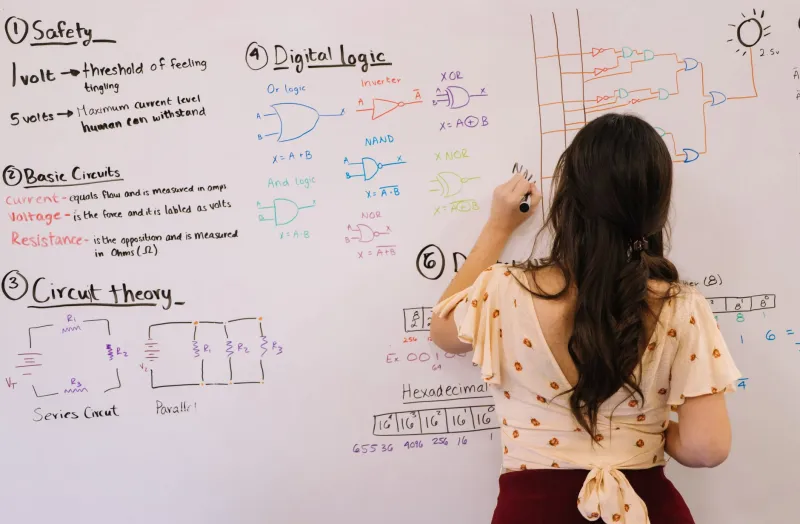
Propositional and predicate logic form the grammatical structure of programming itself. Conditional statements, loop invariants, and database query languages are all formalized expressions of logical relationships. A developer who cannot reason fluently about truth tables and logical equivalence is, in a meaningful sense, working without a complete set of tools.
Set theory, meanwhile, provides the conceptual scaffolding for relational databases, type systems in modern programming languages, and the formal semantics of APIs. When engineers argue about whether two data schemas are compatible, they are often arguing, implicitly, about set-theoretic relationships.
Graph theory — another discrete mathematics staple — models social networks, routing protocols, dependency trees, and recommendation engines. It is almost impossible to work seriously in any area of modern software infrastructure without encountering graphs.
A Curriculum Designed for a Different Era
Despite this pervasive relevance, discrete mathematics occupies a marginal position in the American K–12 mathematics curriculum. The standard progression — arithmetic, algebra, geometry, precalculus, calculus — was largely codified in the mid-twentieth century, when the dominant vision of mathematical preparation centered on physics and engineering in a Cold War industrial context. Calculus was the summit because calculus was what rocket scientists needed.
That logic made sense in 1965. It is considerably less persuasive in 2025, when a larger proportion of mathematically intensive careers involve writing code, analyzing data, or designing systems than involve solving differential equations by hand.
"We are essentially preparing students for a workforce that no longer exists, at least not in the proportions it once did," said Dr. Miriam Chen, a mathematics education researcher at a public university in the Midwest who has spent the past decade studying curricular alignment between secondary education and technology industry needs. "Calculus is a beautiful and important subject. But for a student who wants to become a software developer or a data analyst, discrete math is far more immediately applicable. We are not giving them that option."
The result is a peculiar situation in which colleges must spend significant instructional time remedying a gap that secondary education created. Many computer science departments require a discrete mathematics course in the first or second year precisely because incoming students have had no exposure to the material. That remediation is not free — it consumes credit hours, delays students' progress into upper-division work, and contributes to attrition among students who find the sudden conceptual shift disorienting.
Industry's Quiet Frustration
Hiring managers in the technology sector have been registering this frustration for years, though often in indirect terms. Technical interviews at major software companies are famously heavy on algorithmic problem-solving — a genre of question that is, at its core, an assessment of discrete mathematics fluency. Candidates who struggle with graph traversal, dynamic programming, or combinatorial reasoning are not struggling because they lack intelligence. They are often struggling because they have never been taught to think in those terms.
The cybersecurity industry presents an even starker case. Cryptographic protocols, the mathematical backbone of secure communication, are built on number theory and combinatorics. Penetration testers and security engineers who cannot reason about these structures are limited in their ability to understand, evaluate, or attack the systems they are meant to protect. Yet the pipeline of candidates with that preparation remains thin.
Artificial intelligence and machine learning, the fastest-growing areas of technology employment, also draw heavily on discrete structures. Boolean satisfiability, probabilistic graphical models, and the formal logic underlying neural network architectures all trace their lineage to discrete mathematics. Graduates who arrive at AI roles with only a calculus-centric mathematical background face a significant learning curve that stronger secondary preparation could have shortened considerably.
Promising Signs and Remaining Obstacles
There are encouraging developments at the margins of the American educational system. A number of states have begun piloting computational thinking curricula that incorporate elements of discrete mathematics, often under the umbrella of computer science education initiatives. Organizations such as the Computer Science Teachers Association have advocated for logic and algorithmic reasoning to appear earlier in the standard curriculum. Some forward-looking high schools have introduced standalone discrete mathematics electives, typically as alternatives or supplements to AP Calculus.
The results, where they have been studied, are promising. Students who encounter discrete mathematics in a well-designed high school course frequently report that it feels more tangible and problem-driven than the continuous mathematics they have studied previously. The subject lends itself naturally to puzzles, games, and real-world scenarios — properties that experienced educators know are powerful tools for sustaining engagement.
The obstacles, however, are structural. Teacher preparation programs have not historically emphasized discrete mathematics, meaning that even schools willing to offer such courses may struggle to staff them. Standardized testing regimes continue to reward calculus preparation. And curriculum change at scale is a slow, politically fraught process.
The Case for Prioritizing the Practical
None of this is an argument against calculus. Continuous mathematics remains essential for physics, engineering, economics, and a wide range of scientific disciplines. The argument is rather one of proportionality and opportunity. A student who plans to study software engineering, data science, or cybersecurity would be better served by a rigorous discrete mathematics course than by a third semester of precalculus review. A student undecided about their path would benefit from exposure to both traditions.
The technology industry's need for graduates who can think combinatorially, reason logically, and model problems as discrete structures is not diminishing. If anything, it is intensifying as software becomes more deeply embedded in infrastructure, healthcare, finance, and communication. American education has an opportunity — and arguably an obligation — to meet that need. The first step is acknowledging that the invisible scaffolding holding up the digital economy was built from mathematics that most students have never been invited to study.