Nodes, Neighbors, and Networks: The Mathematical Science Every Student Should Be Studying
Ask a high school student what geometry is useful for, and the honest answer you will most likely receive involves triangles, proofs, and the distant memory of a compass and straightedge. That is not entirely the student's fault. For generations, geometry instruction in American schools has been largely confined to the plane—flat shapes, static figures, and theorems that feel disconnected from the world outside the classroom.
Yet one of the most consequential branches of modern mathematics is built entirely on geometric principles, and it is shaping careers in medicine, cybersecurity, urban planning, and social science. It is called network science, and most students have never heard of it.
What Network Science Actually Is
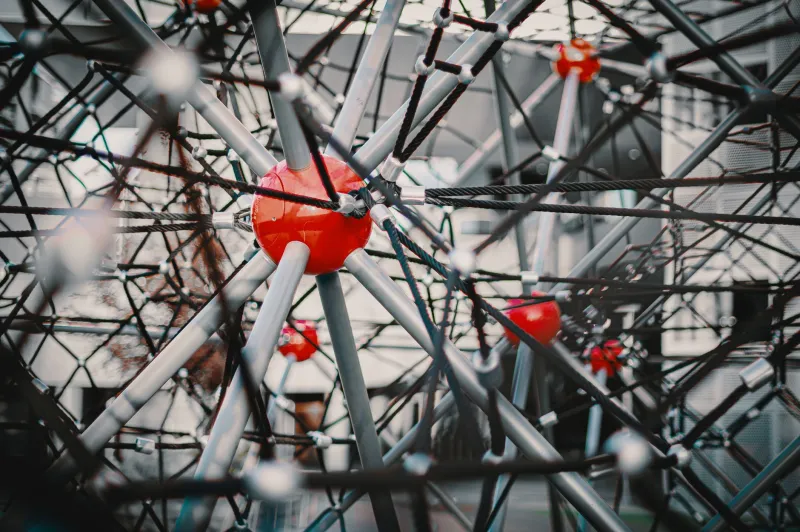
At its core, network science is the mathematical study of how things connect. Formally, these structures are called graphs—collections of nodes (individual entities) and edges (the relationships between them). A node might represent a person, a computer, a city, a protein, or a webpage. An edge might represent a friendship, a data packet, a highway, a molecular bond, or a hyperlink.
What makes this field so compelling is not the abstraction—it is the universality. The same mathematical framework that describes how a flu virus spreads through a middle school also describes how a rumor travels across Instagram, how power grids fail during storms, and how a job opportunity reaches someone three connections away from the original posting.
Concepts like centrality (which nodes matter most?), clustering (do my friends tend to know each other?), and flow (how efficiently does information or disease or traffic move through the system?) are not merely academic. They are the analytical vocabulary of public health officials, intelligence analysts, logistics engineers, and product managers at some of the largest technology companies in the country.
Why Geometry Class Alone Is Not Enough
Traditional geometry gives students a powerful set of tools for reasoning about space, shape, and structure. But it rarely teaches students to ask the question that network science centers on: How does the structure of a system determine its behavior?
Consider the COVID-19 pandemic. Epidemiologists did not just track case counts—they mapped transmission networks, identified superspreader nodes, and modeled how removing certain connections (through quarantine or vaccination) could fragment a network and slow the spread of disease. That kind of thinking requires mathematical literacy that goes well beyond calculating the area of a polygon.
Or consider social mobility. Research from economists at Harvard and other institutions has demonstrated that the composition of a person's social network—not just the size of it—is one of the strongest predictors of economic opportunity. Students who understand network structure are better equipped to interpret that research, advocate for policy changes, and build their own strategic connections in an increasingly networked economy.
The Concepts Students Can Start With
One of the great pedagogical advantages of network science is that its foundational ideas are genuinely accessible. Students do not need calculus or advanced algebra to begin reasoning meaningfully about networks. Here are a few entry points that work well in a classroom setting:
Degree and Centrality: Every node in a network has a degree—the number of edges connected to it. A node with a high degree is, in simple terms, well-connected. But degree centrality is only one measure of importance. Betweenness centrality identifies nodes that serve as bridges between different parts of a network, making them critical for information flow even if they are not the most popular node in the room. This concept alone opens rich discussions about influence, vulnerability, and power.
The Small-World Phenomenon: Most students are familiar with the idea of six degrees of separation—the notion that any two people on earth are connected through a surprisingly short chain of acquaintances. Network science formalizes this observation and explains why it occurs in so many real-world systems. It is a concept that immediately captures student curiosity and leads naturally into deeper questions about clustering coefficients and path length.
Robustness and Vulnerability: Some networks are highly resilient to random failures. Others collapse quickly when key nodes are removed. This distinction has enormous practical implications in cybersecurity, infrastructure design, and public health. Having students simulate network attacks—removing nodes and watching connectivity degrade—is both engaging and mathematically illuminating.
Career Pathways That Run Through This Field
The professional relevance of network science is difficult to overstate. Consider the breadth of fields where this knowledge is actively applied:
- Epidemiology and Public Health: Contact tracing, outbreak modeling, and vaccination strategy all depend on network analysis.
- Cybersecurity: Understanding how malware propagates through connected systems is fundamentally a network problem.
- Social Science and Policy: Researchers use network methods to study polarization, misinformation, and community formation online.
- Supply Chain and Logistics: Identifying bottlenecks and single points of failure in global supply networks is a network optimization problem.
- Finance: Systemic risk in banking systems is modeled using network frameworks to understand how a single institution's failure can cascade.
For students who are drawn to any one of these fields, a foundational understanding of network science is not just helpful—it is increasingly expected.
Making the Case for a New Elective
Some forward-thinking school districts across the United States have already begun integrating data science and discrete mathematics into their curriculum offerings. Network science fits naturally within that expansion. It requires no specialized laboratory equipment, translates seamlessly into project-based learning, and connects to topics students are already thinking about: social media algorithms, viral content, online privacy, and the spread of misinformation.
A well-designed network science elective could use free tools like Gephi or NetworkX (in Python) to let students visualize and analyze real datasets. Students could map their own classroom social network, analyze publicly available data from Twitter or Wikipedia, or model how a hypothetical disease would spread through their school. The mathematics is real, the data is real, and the insights are immediately meaningful.
For educators concerned about curriculum alignment, it is worth noting that network science reinforces core concepts in algebra (functions and variables), statistics (distributions and sampling), and computer science (algorithms and data structures). It does not displace existing content—it connects it.
A Mathematical Lens That Fits the Moment
One of the recurring challenges in mathematics education is convincing students that what they are learning matters beyond the test. Network science does not have that problem. The structures it studies are woven into the fabric of daily life—every search engine query, every social media recommendation, every contact tracing effort, every financial transaction moves through a network of some kind.
Teaching students to see those structures, name them mathematically, and reason about their behavior is not just good pedagogy. It is preparation for a world that increasingly rewards people who understand how systems—and the people within them—are connected.
The nodes are already there. It is time students learned to read the edges.